
So Long, and Thanks for All the Competencies Or: Don’t Panic. It’s Just a Wave Function.
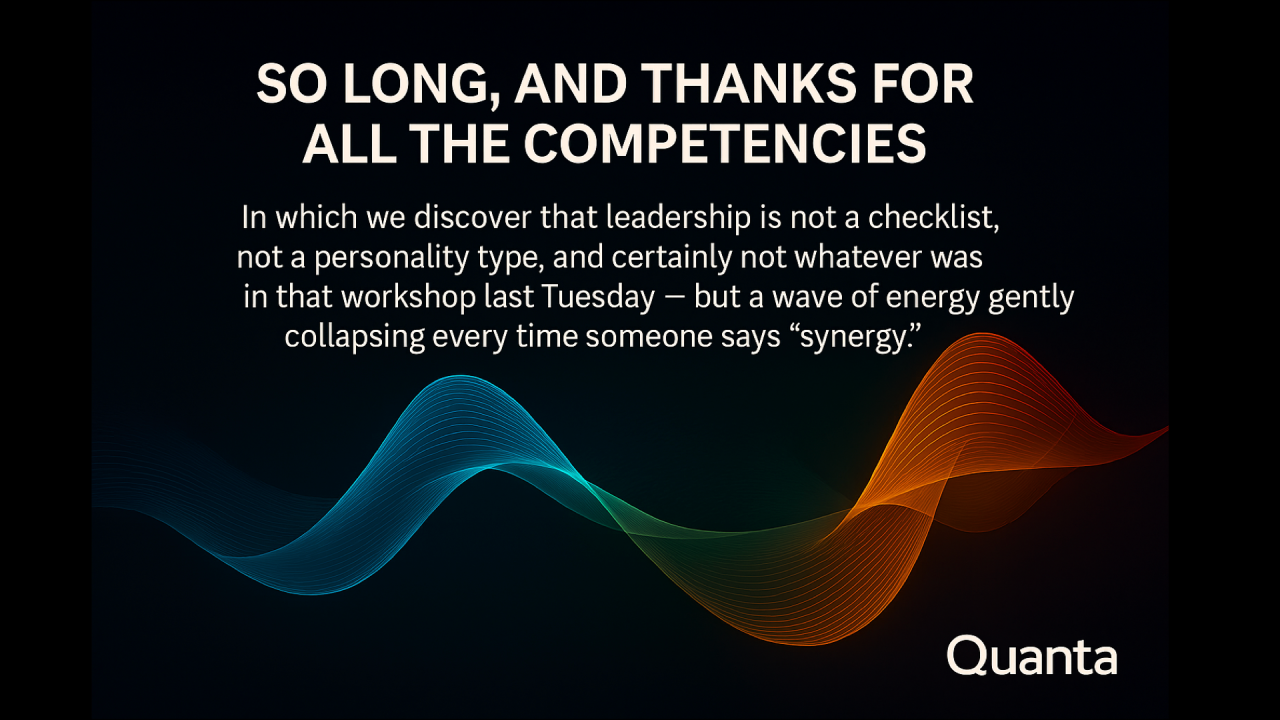
For decades, leadership experts, consultants, and the occasional well-dressed HR person have assured us that leadership can be measured — and more importantly, taught — with just the right combination of competencies, personality types, and 3-hour workshops featuring mints and flipcharts.
This is, of course, a colossal misunderstanding of the nature of the universe.
The Problem with Particles
You see, most of what we call “leadership tools” are really particle detectors. They observe tiny fragments of human behaviour, after they’ve already happened, and with the enthusiasm of a snail at a philosophy lecture.
Examples include:
Competency models (Aka: “Things You Should Have Done But Didn’t”)
Engagement surveys (Taken three months after people stopped caring)
Personality tests (Which would be cute, if they didn’t cost a fortune per report)
360° assessments (A way to hear from everyone except the people who actually matter)
Workshops (Great for coffee. Terrible for actual change.)
Leadership Training Programmes (Somewhere, deep in the universe, a star dims every time someone says 'authentic leadership.')
Each one is a snapshot in time, a frozen particle suspended in the lab of leadership fantasy, labelled and dissected as if the universe weren't moving on without it.
Unfortunately, real leadership doesn’t sit still long enough to be tested.
Because leadership is not a particle. It is a wave.
Welcome to the Wave Function
Leadership is a 4D wave function, rolling and rippling across:
Time (goodbye frozen reports)
Energy (hello vibrational chaos)
Space (multiple teams, locations, dimensions)
Consciousness (variable)
It’s not who you are — it’s what you’re radiating. Not what’s written in your competency framework, but how your energy moves through people, decisions, and moments.
We’re talking about:
Amplitude – how much energy you bring
Velocity – how fast it moves
Frequency – how often it repeats
This is not spiritual mumbo-jumbo. This is wave physics for leadership energy. And if your HR department isn’t sweating yet, it really should be.
The Three Zones of Leadership Energy (And Why Nobody Mentions Them)
Instead of looking at isolated behaviours like a confused cat watching a laser pointer, try seeing leadership through the three energy zones:
Think – Generating clarity, intent, strategy
Act – Converting thought into motion
Interact – That chaotic soup of influence, emotion, and collective intelligence
These aren’t “competencies” — they’re dynamic energy fields. They flow, they collide, they cohere, and occasionally they explode at board meetings.
You can convert them into GC Index proclivities (Game Changer, Strategist, Implementer, Polisher, Playmaker) — think of them as energy flavours of leadership action. But remember: it’s still a wave.
What the Particle People Forgot
The problem with particle-based tools is not that they’re inaccurate. It’s that they only tell you what was, not what is or could be.
They slice open the frog of leadership and declare:
“Interesting specimen. Shame it’s dead.”
Meanwhile, the real leadership system — the living wave — is flowing through relationships, decisions, and dynamics right now.
And your report? Still in the inbox.
From Snapshots to Symphonies
Leadership isn’t a frozen image. It’s a symphony of energy, with rhythm, motion, and discordant jazz solos.
You don’t need another assessment. You need to tune the wave.
That means:
Measure energy, not personality
Track flow, not fragments
Design new energy fractals, not frameworks. (The initial conditions that drive new evolutionary pathways.)
Because the future of leadership isn't about describing static traits — it’s about activating energetic systems.
Epilogue
If you're still looking for the perfect leadership model, here's a handy tip from the universe:
"Don’t Panic. Just ride the wave."
And maybe — just maybe — stop pretending your organisation’s leadership can be fixed by another laminated competency framework.
So long, and thanks for all the particles.
