
The GC Index as a Proclivity Wave: Why Balanced Energy Beats Heroic Leadership
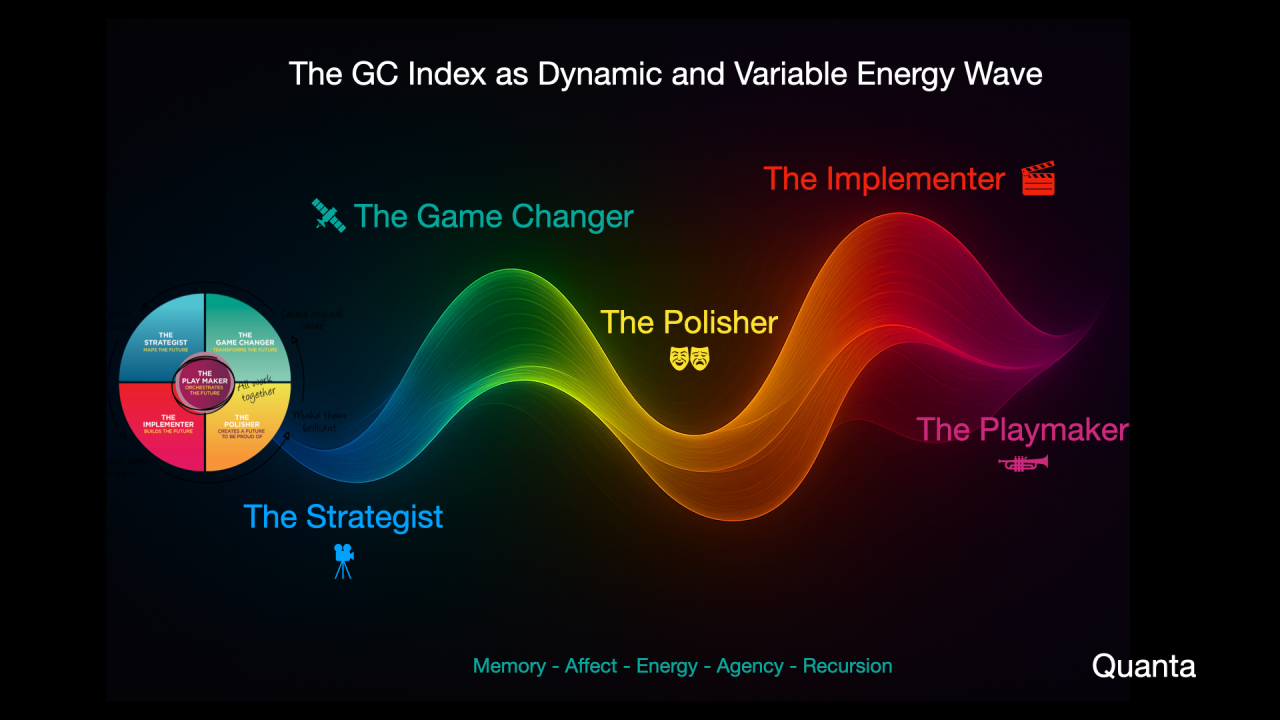
Balanced proclivity waves → stronger team energy wave → better ROI.
“As Plato might have said: Most organisations lead by chasing the shadows on the cave wall. The five GC Index proclivities help us turn toward the source — the real patterns of energy and contribution that shape a team’s destiny.”
Executive Summary
Most leadership teams don’t fail because of weak people — they fail because their energy is unbalanced. The GC Index shows that every leader contributes through one of five distinct proclivity waves: Game Changer, Strategist, Implementer, Polisher and Playmaker.
Each wave carries a different amplitude and frequency, and only when they are combined and balanced does a team generate the sustained Organisational Energy that drives performance, innovation and ROI.
For CEOs, the core message is simple:
Your business results are a direct reflection of your team’s energy wave.
If one or two proclivities dominate, the organisation stalls, burns out, or becomes blind to disruption. But when leaders consciously tune all five waves — using targeted development, better collaboration, and continuous rebalancing — the team becomes faster, smarter, more resilient and vastly more effective.
The bottom line:
Balanced proclivity waves = higher team energy = stronger ROI. This is the practical power of the GC Index when seen not as a particle tool, but as the energy wave map of leadership impact.
Revealing the Power of the Energy Wave
Energy in organisations doesn’t flow in straight lines. It pulses, spikes and ripples through teams like a series of overlapping waves.
The GC Index® is usually described as a measure of five “proclivities”. I’ve started to see it differently: as five distinct leadership energy waves that, when combined, create one integrated team wave.
And that has big implications for how we build and develop leadership teams.
Five Proclivities, Five Waves
“As Einstein might have put it: Leadership, like light, behaves both as particle and wave. The mistake is to look only for the leader as a particle, instead of measuring the five waves of energy through which the team actually does its work.”
The GC Index doesn’t tell you who you are as a personality. It shows where and how you are most energised to make an impact.
Each proclivity is a different wave of leadership energy, demanding different amplitudes and frequencies over time.
Game Changer – disruptive, future-creating energy. Generates original ideas, challenges assumptions, spots opportunities others miss. Very high amplitude/Low frequency.
Strategist – pattern-seeing energy. Joins the dots, maps the landscape, turns ideas into coherent choices. High amplitude/Medium frequency.
Implementer – execution energy. Turns decisions into plans, and plans into delivered outcomes. Medium amplitude/High frequency.
Polisher – refinement energy. Pushes for excellence, removes defects, makes things “brilliant not just good enough”. Medium amplitude/medium frequency.
Playmaker – relational energy. Builds trust, aligns people, holds the system together through conversation and collaboration. Variable amplitude/ medium frequency.
Each has its own amplitude (how strongly it shows up) and frequency (how often it’s needed). On their own, they’re powerful. But the real magic happens when they combine into one complex wave – the leadership energy signature of a team.
From Five Separate Scores to One Integrated Team Wave
“As William James might have said: Leadership is not a trait but a stream of habit and attention. The five GC Index proclivities are simply the organised channels through which a team’s living energy is directed into intelligent action.”
Most teams look at their GC Index report as five energy scores on a page. Useful – but incomplete.
If we treat those five proclivities as waves, a different picture appears:
The shape of the combined team wave shows how the team thinks, acts and interacts over time.
Large spikes in one area and flat lines in another reveal systemic blind spots.
A more balanced wave – where all five proclivities are present and valued – predicts higher, more sustainable Organisational Energy and, in time, better ROI.
Examples:
A team high in Game Changer + Implementer, but low in Polisher + Playmaker, will generate bold ideas and move fast – but may burn people and customers with poor quality and weak engagement.
A team strong in Strategist + Polisher, but low in Game Changer, may craft beautiful plans and refine endlessly – but struggle to disrupt itself or the market.
A team low in Playmaker may be clever and hardworking – but brittle when pressure hits.
The question for leadership teams is no longer, “Who is our star?” It becomes, “What does our team wave look like – and where is it unbalanced?”
The Power Law: Why Different Waves Matter at Different Times
“As Douglas Adams might have put it: Most companies still treat leadership like a solid little particle—when in fact it behaves far more sensibly as a slightly bewildered wave trying to decide where to go next.”
Organisations don’t operate on a smooth, even rhythm. They follow a power law of energy demand:
Long stretches of high-repetition, lower-intensity work
Interrupted by low-repetition, high-intensity events – crises, transformations, strategic bets
Each proclivity is stressed differently across this landscape:
Implementer & Polisher carry much of the repetitive, day-to-day load: operations, delivery, continuous improvement.
Game Changer & Strategist are critical in those rare but pivotal moments where direction must change or a new model must be created.
Playmaker flexes across both – sustaining relationships in the everyday and keeping people connected when the wave spikes.
If a team overuses one wave and underuses another, it either:
stalls (lots of ideas, little execution),
burns out (constant execution with no renewal), or
fractures (poor relational glue when stress rises).
Reading the power-law demand on the system – and consciously rebalancing the five waves – becomes a core leadership skill.
Leadership Development as Wave-Tuning, Not Sheep-Dipping
“As Wittgenstein might have put it: The meaning of ‘leadership’ is in its use. Watch how the five proclivities are actually used in the language games of a team, and the vague word dissolves into clear patterns of energy and action.”
This is where training and development need to change.
Traditional leadership programmes treat everyone the same: generic competencies, long lists, heroic ideal leader archetypes. In wave terms, that’s like trying to iron out all the peaks and valleys into one flat line.
Using the GC Index, we can do something smarter
Map the team wave
Design targeted “wave labs” rather than generic modules
Practise the full wave on real business problems In workshops, run live issues through a five-step wave exercise, using the power of Lego Serious Play.
Build a continuous Leadership Development Lab to maximise team capability in all five proclivities. (Our research confirms that teams with balanced energy across all five proclivities generate superior results.)
Leadership development becomes wave-tuning, not sheep-dipping.
Why This Matters for ROI
When leadership teams maximise all five proclivity competences, several things happen:
Better ideas (Game Changer)
Smarter choices (Strategist)
Faster execution (Implementer)
Higher quality and reliability (Polisher)
Stronger trust and engagement (Playmaker)
That combination increases:
Amplitude – the strength of the team’s overall energy
Stability – the team’s ability to ride the power-law spikes without burning out or breaking down
Conversion – the rate at which leadership energy turns into real outcomes: profit, innovation, customer loyalty, and long-term resilience
In other words:
Balanced proclivity waves → stronger team energy wave → better ROI.
A Question for Your Leadership Team
If you looked at your current leadership team through this lens:
What does your GC Index team wave actually look like?
Which proclivities dominate? Which are almost flat?
Where are you over-using some energies and under-using others, given the power-law demands of your market?
And the most important question:
What would it take to tune your leadership team into a full, balanced five-wave system – rather than relying on one or two heroic spikes?
That’s the conversation the GC Index, seen as a proclivity wave, invites us to have.
