
A Deeper Dive into The GC Index and Leadership Energy for Impact
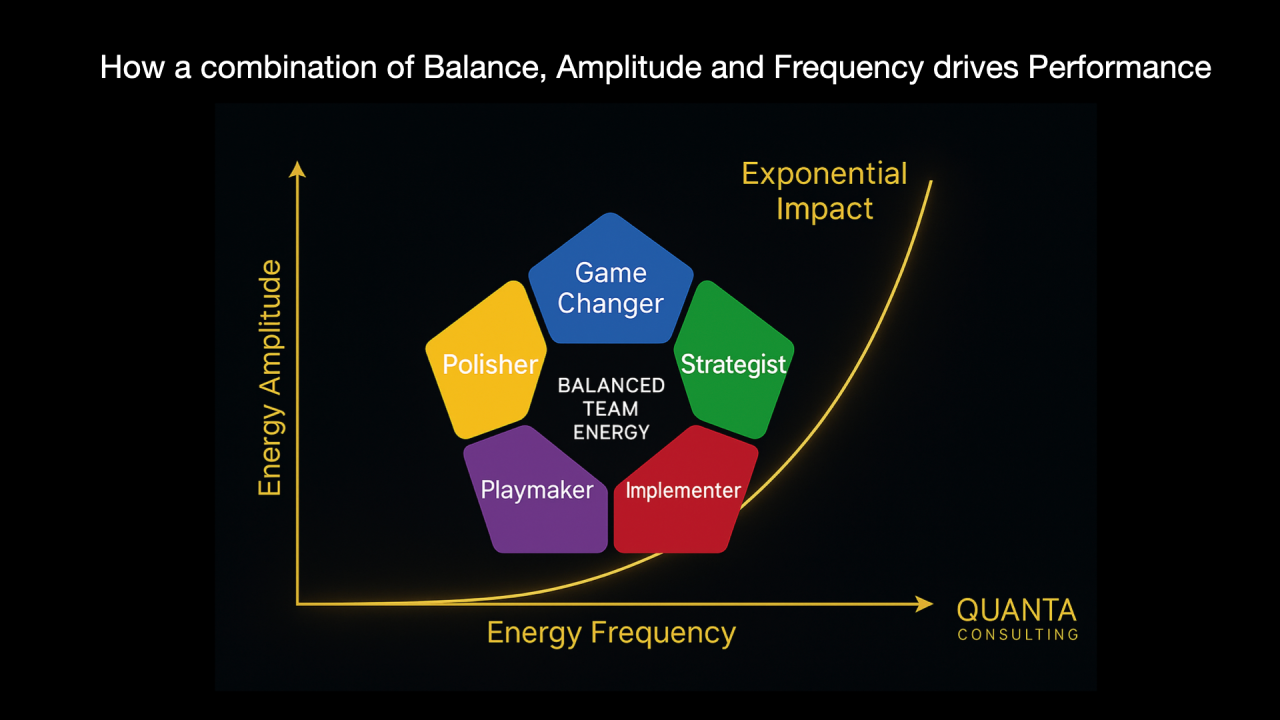
uanta's recent research confirmed that the most successful teams have both high energy and balanced profiles. We found that leadership teams when measured with The GC Index Team Profile incorporate a genuinely powerful, important but invisible DNA that accurately predicts performance and profitability.
This is a highly significant, even revolutionary finding. It separates the signal from the noise.
Just as the quality of wine is determined by the quality of the vineyard, so too is the ROI of an organisation determined by the Return on Leadership Team Energy, the system's ROE. Read below if you wish to learn more. We also reveal the true source of all new system energy - a little like finding the source of the Nile! Refer to our previous blog for more detail on this research. https://www.linkedin.com/feed/update/urn:li:activity:7366035685306175488/
In today's blog we dig deeper into understanding balance and the importance of both amplitude and frequency of energy in the five different proclivities of The GCIndex.
How Quanta Defines Energy
It is important to remember the following. We live in a world of energy, but nobody knows exactly what this mysterious element is. Instead we measure energy by the way it manifests in action. Such as temperature, gravity, speed and even intelligence, religion and civilisation. All are the product of energy in action.
At an organisational level we say that all performance is the product of system energy. Without energy, strategy remains but so much chaff blowing in the wind.
And this mysterious energy, is quite simply, the product of Leadership Energy.
But what then is this Leadership Energy? We define it in terms of the three actions we can take. Thinking, Acting and Interacting. And it is the integration of these three elements that generates system energy.
This matches perfectly to the five proclivities of the GC Index. Thinking - Game Changing and Strategy. Acting - Implementing and Polishing. Interacting with others - Playmaker.
Now if we look at a leadership team it is intuitively obvious that the most intelligent and successful teams will have a balance of high energy in all five proclivities. A team with high Game Changing and low Implementer would lead to chaos. Lots of great new ideas and no action.
The Thinking Proclivities:
Game Changing; to act as the evolutionary energy valve to let new and better ways of doing things into the system. Without Game Changing a system will simply atrophy and die.
Strategy; to convert the new energy into a structured and practical journey. The blueprint for future success.
The Acting Proclivities:
Implementing and Polishing. The process of delivering the right quality on time at the right price. Most organisations and their managers tend to focus here to maximise efficiency and profitability. Finding new and better ways, endless meetings and PP slides are anathema. The real danger is that obsession here has the shadow of self destruction through ignoring the essential survival role of continuous evolution.
The Interacting Proclivity:
The Playmaker, the ability to care about individuals, creating a climate or context to maximise the contribution of every employee and team. This is the complex and invisible glue that holds everyone in a high energy space.
The Leadership Team as the 'Real Engine' to drive Performance
The Leadership team is much more than a collection of individuals. It operates at a higher level of complexity, in a world that is non-linear and dynamic. And that is precisely why the team needs high energy in all five proclivities. It has to deliver and compete effectively in all five areas for the engine to deliver at maximum torque. You cannot run a five cylinder engine efficiently if one or more cylinders are broken.
Can you imagine the coach of the new young tennis star, Alcaraz, saying to him: "You have a great forehand, which is much stronger than your backhand. Let's ignore that and see how well you do with just your forehand."
The Exponential and Dynamic Nature of Human Energy. Driven by Amplitude and Frequency.
(Note. The following views are based on the work of Quanta alone and may not necessarily reflect the views of The GC Index.)
The GC Index uses a 1 - 10 scale based on a linear ladder with equal gaps: 2-4-6-8 etc.
This linear approach, for example, would show the gap between an 8 and a 10 Strategist as an increase in energy of 25%. Our hypothesis is different. We believe, from evidence, that the gulf in energy potential may be huge and significant between an 8 and a 10 and could be as high as 75% or three times higher than a linear assumption of 25%. (This is based on our new Quanta energy algorithm.)
Think of any of the names that have changed the world. From mathematicians and scientists, to philosophers and politicians, and to the tech leaders of our modern world. They all share the characteristics of obsession, intelligence, creativity, courage, determination - and they are all off the scale for energy amplitude (maximum energy) combined with high frequency of this energy over time.
In contrast think of a manager with a 5 Strategist. Firstly this energy level will present differently in both thinking and action - lower amplitude, and secondly may weaken quickly under pressure or opposition - lower and dissipating frequency.
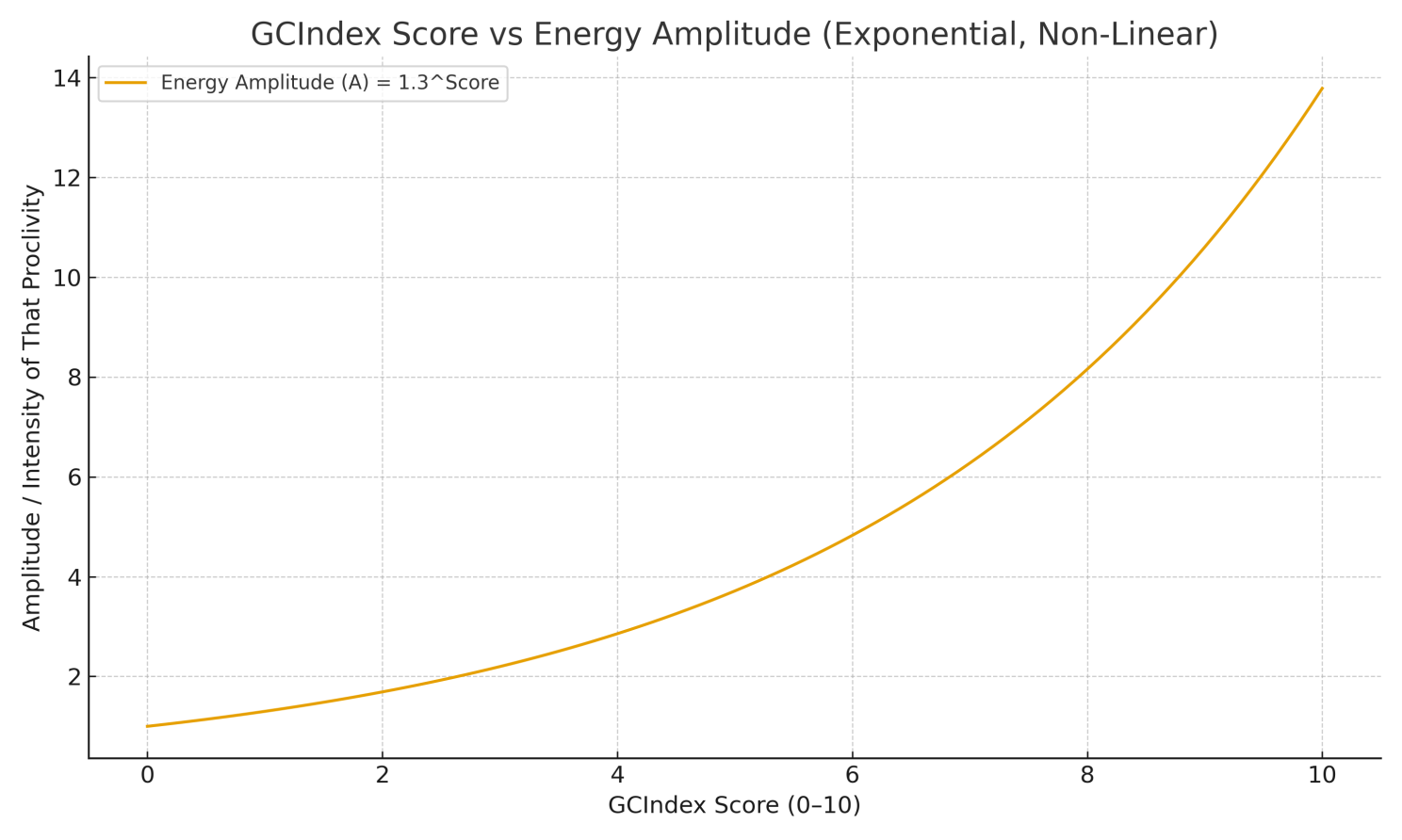
Energy for impact increases exponentially the greater The GC Index proclivity score
Amplitude, Frequency and The GC Index Proclivities
The graph above shows how we view the exponential nature of human energy when using The GC Index Profile.
Let's now look at how the same scores in different proclivities may present.
We assume for this exercise a 10 Game Changer and a 10 Implementer. How do they differ?
The natural instinct of the 10 Game Changer is to always look to change the world by finding new, better and different ways of doing things. But not every day. Thus the role of the high energy Game Changer is to be the inventor, to find the new unexplored pathway that may guarantee the future success of the company.
Thus the ideal energy wave of the Game Changer will have the highest possible amplitude matched by a moderate to low energy frequency. Otherwise there will be chaos in the system.
The 10 Implementer is different. They abhor change and disruption. They just want things to go smoothly, efficiently and predictively. In general they would invite the 10 Game Changer to stay as far away as possible!
Thus the ideal 10 Implementer will have a moderate energy amplitude with a high and consistent frequency.
This difference is shown in the diagram below.
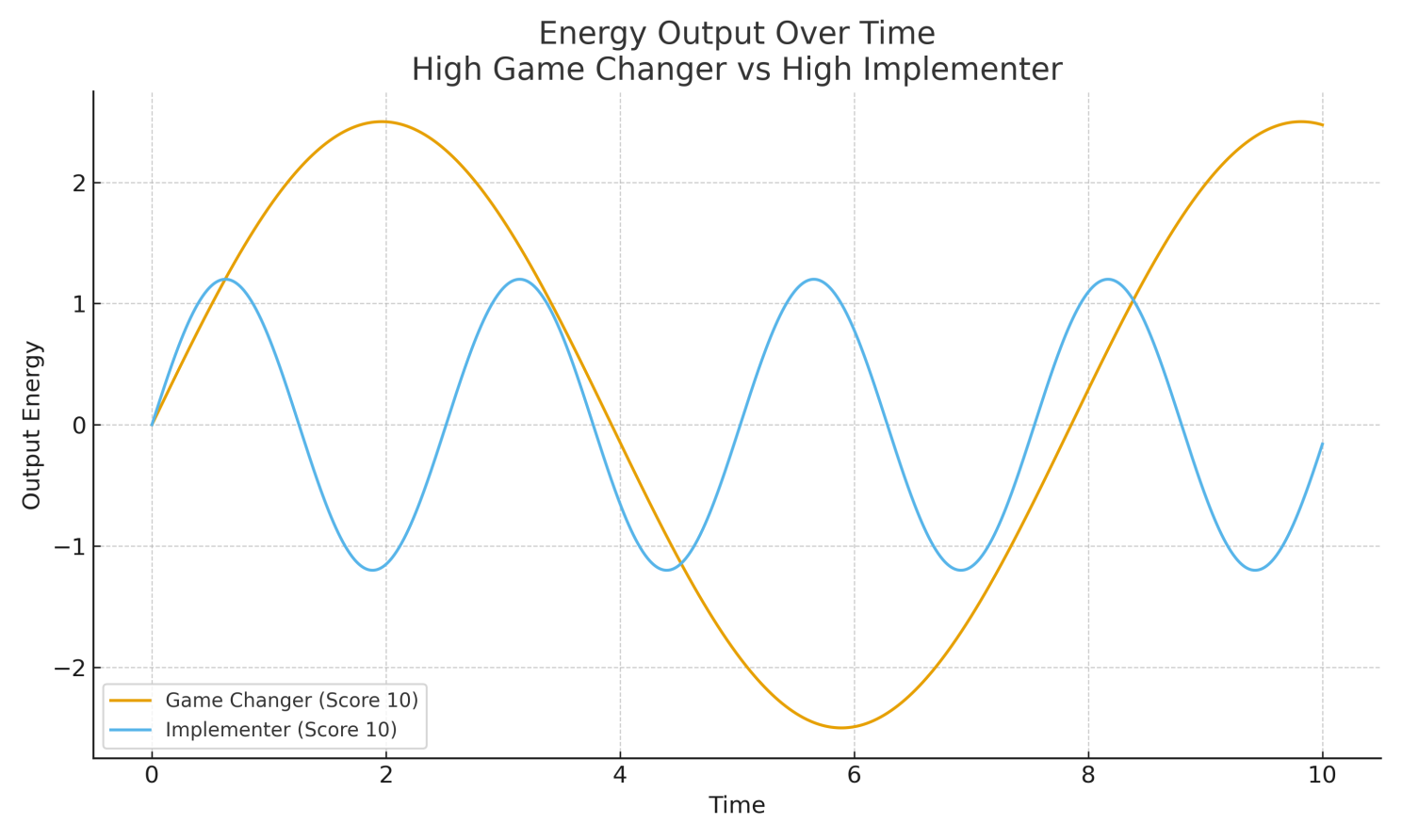
Game Changer is High Amplitude/Low Frequency. Implementer is lower Amplitude and High Frequency.
What’s next?
This now opens the door to a deeper understanding of the dynamic energy requirements of every role in an organisation to meet specific strategic objectives.
What's next?
At Quanta our core strategy is to generate new levels of organisation energy and performance through building high energy leadership teams.
Our current development step is to create our own practical framework or matrix that combines different job sizes in different job families - Sales vs Operations for example, combined with our own Quanta Job Profiles based on The GC Index profiles, and requisite energy amplitude and energy frequency.
We will also link this to our method of assessing potential candidates for 'best fit'.
The strategic purpose is to offer clients a one-stop-shop to maximise leadership energy, organisational energy and overall performance.
