
Organisation Energy - The New Spirit of Our Time
The concept of 'energy' has been slipping quietly into the management lexicon in recent times. We welcome this new Hegelian zeitgeist. In 1995 we pioneered our novel concept of defining, measuring and generating energy in organisations. We now have the research and data that confirms that ROI is always the product of ROE, or Return on Energy.
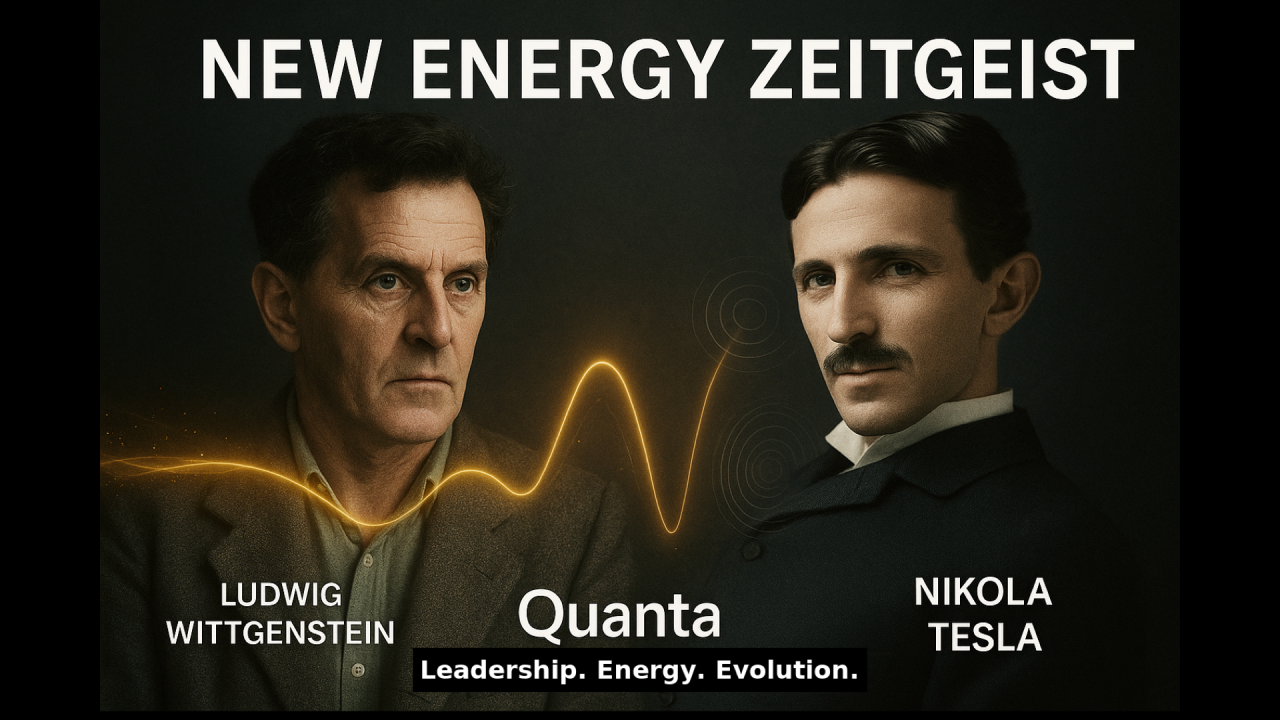
Due to the evolutionary importance of this global shift, we have also invited the voices of two special geniuses. The famous philosopher and thinker, Ludwig Wittgenstein, and the scientist and thinker Nikola Tesla.
Energy is the key to organisational performance because it is the invisible currency that powers focus, action, innovation, and alignment — without it, even the best strategy will fail.
The timing is no coincidence. A key element of Organisation Energy is intelligence - how we think, act and interact. Intelligence is an emergent property of our civilisation. And now we are at the dawn of the new age of artificial intelligence, the natural evolution of human thinking. A new injection of universal energy, the very fuel that drives life and consciousness.
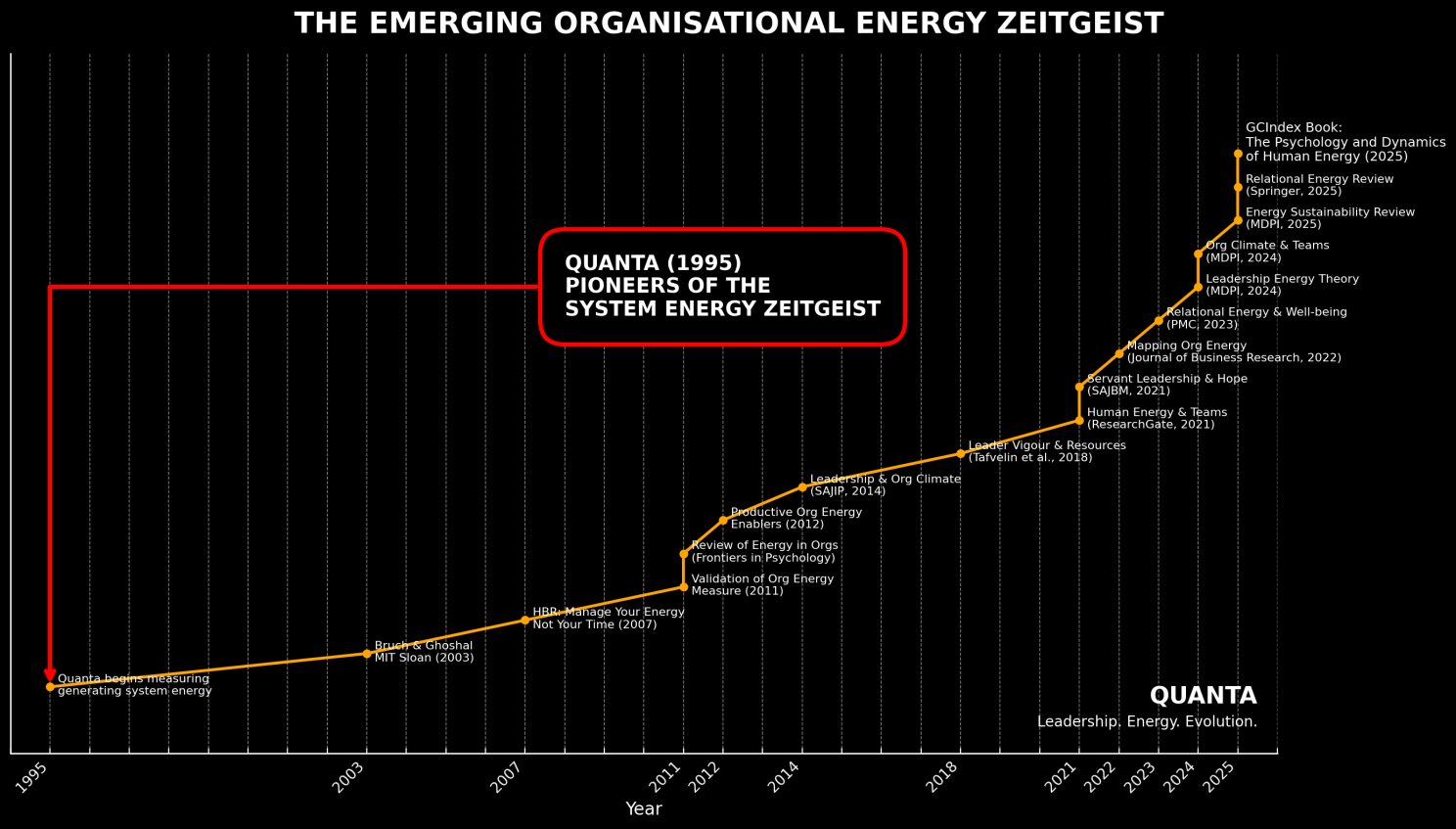
We are already in the new zeitgeist. There is no way back. The graph below tracks its history. Slow at first, and now accelerating at an exponential rate. The GC Index, our energy partner, provides the latest practical contribution to the energy zeitgeist with their recently published The Psychology and Dynamics of Human Energy.
In the decade ahead, leadership will be re-configured in terms of energy, the science behind it, and the natural laws that drive it.
Let's hear now from our two geniuses.
Wittgenstein on the Energy Zeitgeist
"The meaning of a word is its use in the language" - Philosophical Investigations
Interpretation
Wittgenstein would see Zeitgeist not as some mystical force but as a linguistic construct — a word whose meaning arises from how people use it in context. The “spirit of the age” is really the grammar of our collective behaviour, the rules and games we follow without knowing we’re playing.
Applied to Energy
“If today’s organisations speak of ‘energy,’ not merely as a metaphor, but as something to be defined, measured, and generated — then that is the form of life we now inhabit. The grammar of leadership has shifted. We no longer just ‘manage,’ we ‘energise.’”
So for Wittgenstein, the “Energy Zeitgeist” is a language game that reveals a deeper cultural shift. It is not about what energy is, but about what we do with the word. Your decades of usage — measuring, fractalising, evolving energy — have subtly reshaped the rules of corporate communication.
The system energy game has become playable because you taught the world new rules.
Nikola Tesla on the Energy Zeitgeist
"If you want to find the secrets of the universe, think in terms of energy, frequency, and vibration."
Interpretation
Tesla would understand Zeitgeist quite literally — the vibrational field of a generation. Each age hums at a certain frequency, a resonant pattern that emerges from its collective inventions, emotions, technologies, and consciousness.
Applied to Energy
“In this moment, the frequency of human systems is shifting. What was once sluggish, siloed and entropic is now vibrating with recursive feedback, emotional thrust, and energetic alignment. Your ‘Energy Fractal’ is not metaphor — it’s the actual modulator of this resonance.”
For Tesla, the emergent Energy Zeitgeist is a resonant wave — a measurable, generative field that can be tuned and amplified. When leaders align their personal frequencies (affect, proclivity) with the system’s, you get resonance. When they’re out of sync, you get static or burnout.
The Energy Zeitgeist is not a metaphor. It is a wavefield waiting for intelligent tuning.
Synthesis
In our own small way, we hope to have contributed to this shift. From a new language game being shaped by cultural shift and altering the grammar of leadership energy to understanding the organisation as a dynamic energy field driven by the laws of nature.
Both would agree:
We didn’t just observe the Energy Zeitgeist — we helped shape it. In words, in waves, in action.
