
AI Demands a Game Changing Response from Humans. Springboks Show the Way.
February 25, 2026
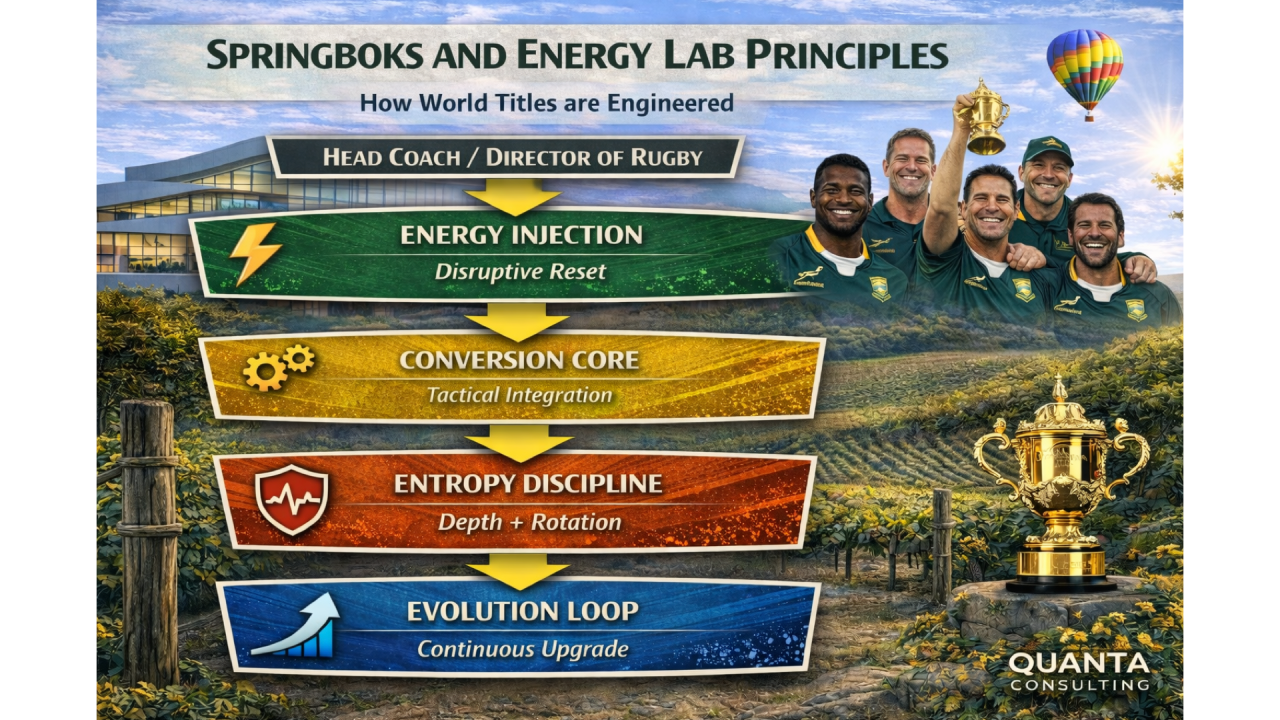
This blog highlights the essential principles of Quanta's Energy Lab that drive evolutionary success in organisations. As an example of successful application I have used the Springbok Rugby Team. The lessons for every organisation are abundantly clear.
🇿🇦 The Springboks Are Not a Talent Story.
They Are a Revolutionary Energy System.
South Africa has won Rugby World Cups in:
1995 2007 2019 2023
That is not a lucky talent cycle.
That is structured evolution.
If AI analysed it coldly, it would say:
The Springboks institutionalised Game Changer energy and built a disciplined conversion engine around it.
That’s the Energy Lab.
High Game Changer Energy Injection
When Rassie Erasmus returned in 2018, he didn’t “boost morale.”
He destabilised the system.
• Rebuilt selection logic • Changed tactical identity • Introduced data-driven planning • Redefined squad depth • Challenged legacy assumptions
That’s not incremental improvement.
That’s directional disruption.
Our recent research has shown four critical findings in organisations, linked to the importance of game changing as a foundational evolutionary skill for all leaders.
Every leadership team's DNA profile, measured by The GC Index Profile, predicts with 95% accuracy, the level of the organisation's energy level and its performance and profitability level. This confirms that all performance is a direct function of measurable system energy.
Every organisation is a complex and open system that can gain or lose energy over time. The role of leadership at a biological level is simple: To continuously inject new energy into the system to exceed energy lost to entropy.
The energy valve that injects new energy into a system is always Game Changing, the 'how can we do this better or differently' proclivity. (This can be measured with The GC Index.)
Dr John Mervyn Smith’s recent research through The GC Index shows something of vital importance to CEO's. As a group, Directors show a Game Changing proclivity three times higher than Board members. This suggests that Directors are chosen to be the warriors, the disruptive innovators, the obsessive and imaginative players, that have the intelligence, courage and drive to find new and better ways of doing things. Board members on the other hand are chosen, not to innovate but to maintain the status quo.
Tongue-in-cheek I describe the former as the Innovator Class and the latter as the Titanic Class. The principle can be extrapolated to every organisation (or sports team) on the planet. Management teams in the Innovator Class stand a chance to innovate, evolve and survive. Those in the Titanic Class? Already sinking.
The Springbok success is a prime example of these findings and principles.
If you want something revolutionary to happen — don’t ask your preservation layer. Empower your disruption layer. This is exactly what Rassie Erasmus, as a uniquely talented Director and Game Changer, has achieved with the Springboks.
The principles he has applied remain the same for every organisation. The advantage of the sports team example is rapid feedback on performance. Eighty minutes to be precise.
This is evolution revealing itself before our eyes.
Playmaker Conversion
Disruption alone doesn’t win World Cups.
Conversion does.
Erasmus and Nienaber built integration:
• Aligned personalities • Blended data combined with intuition • Created role clarity • Managed emotional volatility
The “Bomb Squad” wasn’t just innovation.
It was integration discipline.
High GC idea. Structured execution. Measured impact.
That’s Game Changer energy converted with Playmaker energy.
Thus the power here is the evolutionary loop between Game Changer and Playmaker. Where disciplined repetition generates insight, intelligence, creativity and evolutionary performance.
Entropy Discipline
Rugby is entropy under pressure:
Fatigue. Injury. Media. Noise. Political tension. Travel load
The Springboks didn’t rely on heroes.
They built depth.
They rotated strategically.
They trained for scenarios.
They reduced variance.
That’s Energy Lab physics.
Repeatable Destabilisation
2019 was not repeated in 2023.
It was upgraded.
• Tactical shifts • Bench evolution • Game management refinement • Psychological upgrades
They re-injected energy.
No legacy protection.
Continuous evolution.
What This Means for CEOs
The Springboks didn’t win because they were motivated.
They won because they engineered:
• Disruption capacity • Integration discipline • New behavioural hardwiring • Risk control • Continuous upgrade loops
Most organisations have:
Governance (entropy control) and Strategy decks (injection rhetoric).
But no structured integration layer. No repetition discipline. No engineered evolution cycle. No system energy management.
So they spike once.
Then decay.
The Brutal Insight
Most rugby nations rely on talent cycles.
South Africa built a system that:
Injects energy. Converts energy. Protects energy. Re-injects energy.
That’s why they regenerate.
Board-Level Takeaway
World titles and sustained EBITDA growth follow the same physics:
Inject → Integrate → Stabilise → Upgrade → Repeat
Rugby is visible.
Organisations are not.
But the physics is identical.
High Game Changer energy combined with:
Strong Playmaker integration
Entropy discipline
Repeated destabilisation
This generates the real magic. Continuous evolution.
The Springboks don’t win because they are stronger.
They win because they institutionalised disruption and disciplined energy conversion.
Not through Board control. Rather through world rugby's finest Director and Game Changer.
That is the Energy Lab.
AI's Diagnosis of SA Rugby
AI would say:
Talent: high (but not uniquely highest)
Physicality: strong (shared globally)
Strategy: solid (many teams have this)
But the differentiator?
Institutionalised Game Changer energy + disciplined conversion + entropy containment.
They built a control system. The backbone of the Energy Lab.
Let’s translate it into what CEO's actually care about
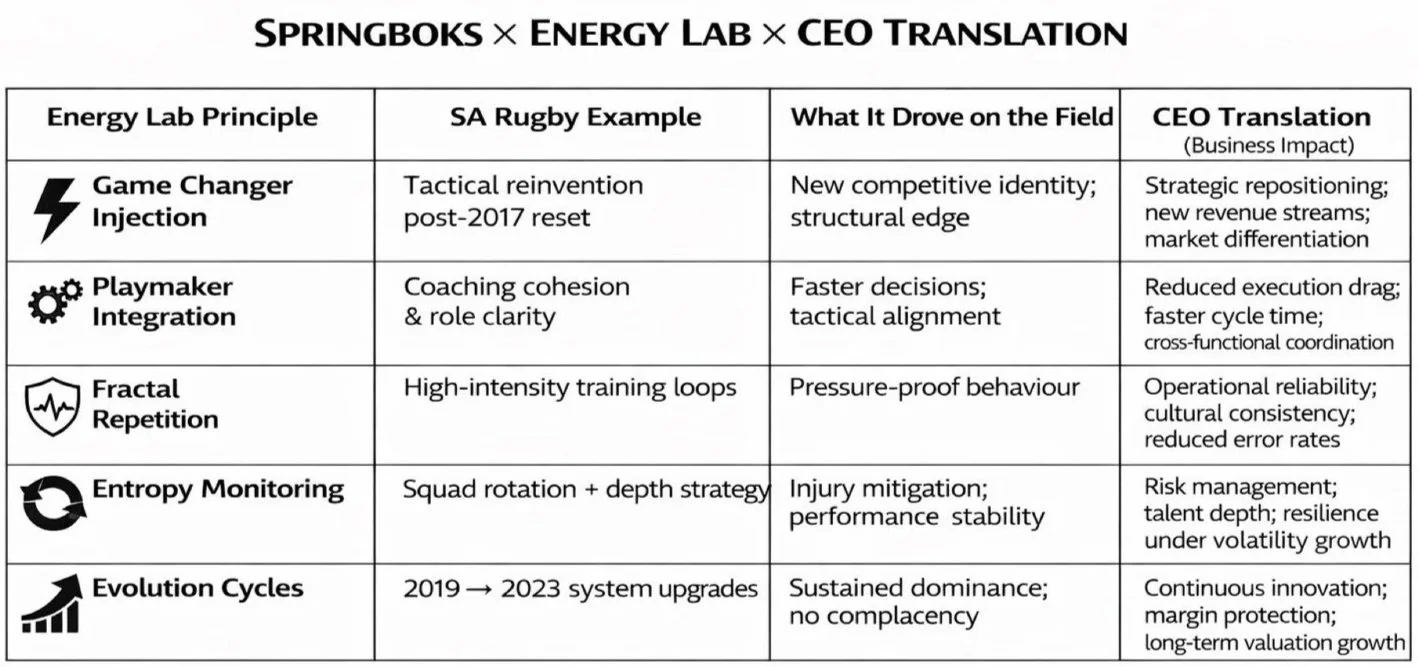
Quanta's Energy Lab Principles Applied to Every Organisation
Conclusion
In a rapidly evolving AI world organisations need to 'evolve at the speed of light' if they hope to survive.
There is an urgent need to let go of the comfortable Titanic Class of Leadership, and replace it courageously and immediately with the 'Disruptive Innovation' Class.
Which of these two runs your organisation?
At least now, you know what to do.
