
Fuzzy Logic and the Energy Curve
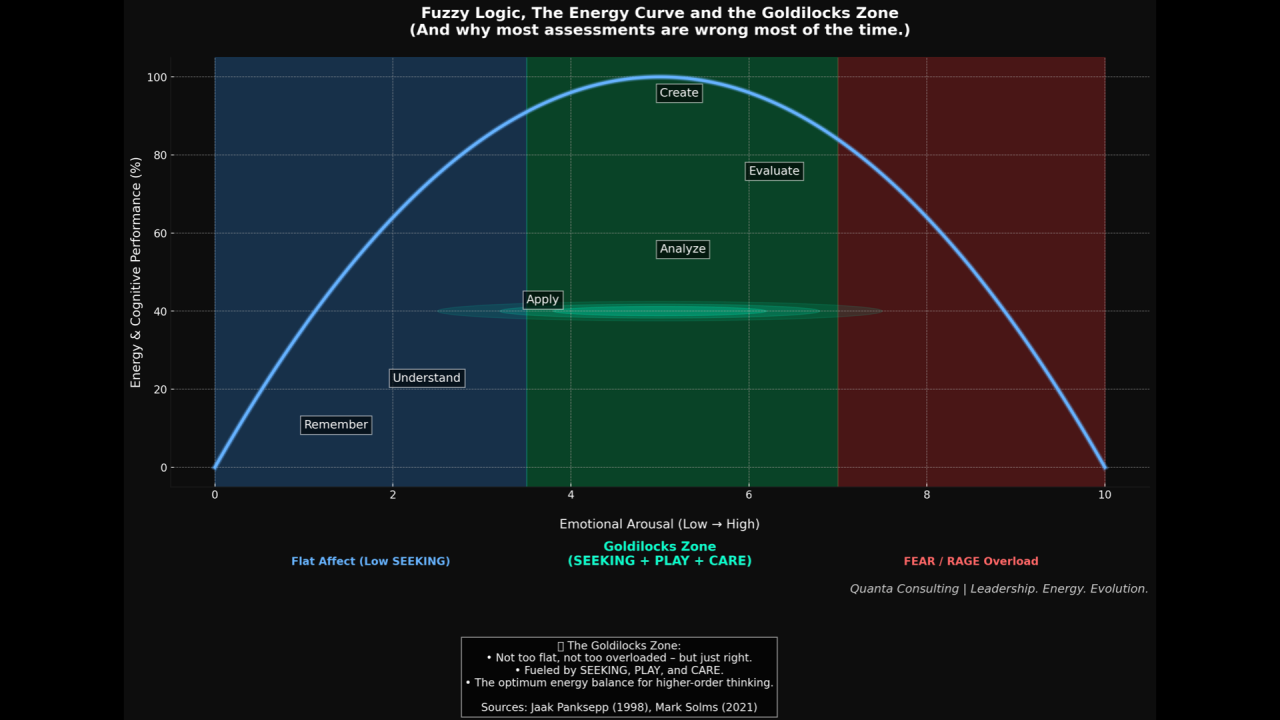
Energy Curve. Concept designed by Quanta Consulting
(And why most assessments are wrong most of the time and how to fix them.)
In Quanta we have assessed thousands of leaders and their organisations over several decades. We have learned some harsh truths.
Assessments are based largely on emotions. Not facts.
The dominant and most powerful emotion is likability. This starts in the brainstem and biases everything from the amygdala to the neocortex.
ALL performance is a function of available energy.
ALL available energy is a complex product of an infinite set of internal and external variables. It is never constant. It follows an energy curve and cannot be assessed accurately.
Energy is driven by affective state. Highest energy, intelligence and capability, are found in the Goldilocks Zone. (See diagram above.)
The goal of leadership therefore is to create a climate or context in the Goldilocks Zone. To maximise system energy and ROI.
To solve this complex dilemma we introduced our Quanta version of fuzzy logic, highlighting a range of behaviours from best to worst. A key finding emerged. The most effective leaders tended to be the most consistent in their behaviour. (Predictable, trustworthy, likability, emotional consistency.)
Now we are taking things a step further. Combining the science of emotions and affective behaviour with cognitive thinking, fuzzy logic, human energy and our Goldilocks Zone, in Quanta's Energy Curve.
Why does this matter? ROI is always a function of Organisation Energy (ROE). And ROE is always a function of Leadership Energy. The Leadership Curve shows leaders how to maximise system energy and consequently ROI.
Feeling Fuels Thinking: How Panksepp, Solms, Bloom & Fuzzy Logic Unlock the Leadership Energy Curve
"The mind is not a logic machine—it’s a living engine, driven by emotion and tuned by curiosity." — Quanta Energy Lab
Most models of leadership, learning, and performance focus on thinking—what we know, remember, or apply. But as cutting-edge neuroscience and energy research show, cognition doesn’t arise from a vacuum.
It rides on waves of emotion, motivation, and energy—and is shaped by contextual variability far more than we admit.
It's time to explore a new leadership operating system that integrates:
Panksepp’s affective systems (emotion-driven brain energy)
Solms’ conscious feeling brain
Bloom’s spiral of cognition
And now: Fuzzy Logic — the key to understanding real leadership behaviour.
The Emotional Engine: Panksepp’s 7 Affective Systems
These are the brainstem’s primal emotional circuits—the operating systems of mammalian motivation:
SEEKING – Curiosity, anticipation, exploration
PLAY – Joyful experimentation, creativity
CARE – Nurturing, bonding, trust
RAGE – Boundary enforcement, anger
FEAR – Threat detection
PANIC/GRIEF – Social loss
LUST – Drive for connection and mating
These systems generate affective states that are conscious (Solms), dynamic, and deeply contextual. They fluctuate minute to minute. They do not produce consistent “traits”—they generate variability.
The Cognitive Spiral: Bloom’s Taxonomy
Cognition evolves upward—from memory to creation—in a six-step spiral:
Remember
Understand
Apply
Analyse
Evaluate
Create
But here’s the trap: we often judge people as if these capacities are fixed.
We do know however that most organisations, driven by cost efficiency etc, focus on levels 1 - 4. This excludes the essential game changing and disruptive innovation at levels 5 - 6, the injection of new energy required to guarantee emergent capability.
Obsession with 1 - 4 is a guaranteed death spiral.
Enter Fuzzy Logic: Why Competencies Fail
In classical logic, we say:
“This leader is a visionary.” “That person is not a good communicator.”
But in the real world of energy, emotion, and context, this is nonsense.
Competency models assume that behaviour is binary and stable. Fuzzy logic shows that behaviour is conditional, variable, and fuzzy.
A leader might be an excellent communicator on Monday at 10am, and a disaster by Thursday afternoon, depending on:
Affective energy (e.g., low SEEKING or high PANIC)
Cognitive arousal (overload or boredom)
Interpersonal dynamics (trust, fear, or conflict)
Environmental volatility (change, threat, ambiguity)
Likability - varies between colleagues
So when assessments label someone as a “visionary” or “resilient” or “not strategic,” they are typically:
Driven by social projection,
Filtered through bias and likability, and
Lacking real energy-state context.
We don’t accurately assess leaders—we imagine them. And therein lies the error.
This is the domain of what Lacan called the Imaginary: reputation, projection, narrative—not fact.
The Goldilocks Zone: Energy Meets Intelligence
Instead of chasing static traits, we focus on energy flow—the intersection of emotion and cognition.
At Quanta, we define the Goldilocks Zone of performance as:
Active SEEKING
Regulated FEAR and PANIC
Open PLAY and CARE
High cognitive capacity (Apply → Create)
This is where real intelligence happens—because the emotional system is fuelling, not hijacking, thought.
Affect + Cognition = Behaviour (in Context)
The table below summarises the important recursive cycle generated first by affect, leading to cognitive expression and actual behaviour.
See content credentials
This is not a fixed chart. It’s a variable cloud of possible states, changing across the day, week, or context. Reflected in the Energy Curve.
Fractal Leadership: A Better Model
Leadership is not a set of traits. It is a fractal pattern of behaviour—formed by:
Energy
Emotion
Context
Repetition
By designing small, repeatable energy fractals (daily practices that activate SEEKING, PLAY, or CARE), at Quanta we know how to shape new leadership states that persist over time—even under pressure.
Summary - Why Traditional Assessments Are Wrong
Most 360° reviews and competency tools are flawed because:
They measure surface impressions, not affective energy
They rely on likability, not dynamic feedback
They treat behaviour as linear and stable, not fuzzy and emergent
In short: most assessments are static tools trying to measure a dynamic reality.
The future belongs to systems that track real-time energy, moment-by-moment behaviour, and fractal feedback loops.
Final Insight: From Trait to State to Energy
"You are not your Myers-Briggs. You are not your last 360. You are not a 'visionary leader' or a 'poor communicator'."
You are a living energy field, changing by the second. Your cognition is shaped by feeling, and your feeling is shaped by energy.
To lead better learn how to enter the Goldilocks Zone. Start designing conditions where SEEKING, PLAY, and CARE can thrive. That's where the real intelligence begins.
Call to Action
Want to replace questionable feedback with real energy insight? Want to build leadership labs that reflect how behaviour actually works? Want to measure the flow, not the fiction?
Explore the Quanta Energy Fractal Method. Learn to design powerful level 5 - 6 Energy Fractals. Shift states. Evolve leadership. Escape the binary.
Enter the curve. And maximise your ROI.
